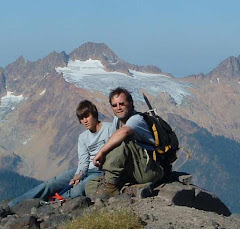
Wednesday, November 18, 2009

An Observation from a Social Experiment


Any time you bring a group of strangers together, from all walks of life, and force them to close quarters with constant interactions . . . it becomes a social experiment.

Think of Gilligan's Island, or the show Big Brother. This was what happened in Nepal. Ten of us medical providers from across the country came together. We met for the first time around an orientation dinner in Kathmandu. Then, the next day we did a tour together. After than, we lived and worked side by side for the following 16 days. We spent the days hiking up the steep mountains together, or working in the clinic. We ate every meal . . . including snacks . . . together. Even at night our individual pup tents had to be crammed side by side on the small terraces that clung precariously to the mountain side. You could hear your new found friends breath, snore, scratch and . . . unfortunately fart.

Each day you watched "alliances" form and fail. You watched romances bud . . . wavier . . . and bud again. It was interesting. One thing that I did observe (again), is how insecure we all are.

Sometimes I know that I am too critical of the farce-factor of Evangelicalism. However, those antagonistic to Christianity (as most of my American buddies in Nepal were, based on their comments) certainly don't have any less of a fraceness. It is amazing how insecure you can be . . . even after getting your PhD and MD from Harvard . . . that you have to constantly talk about (and embellish about ) your accomplishments.

So my lesson was this. When I get tired of the pretentiousness of Christians (including myself) and start to wonder, "Maybe truth is found elsewhere," I am once reminded that the honestly grass is not greener there. Like when Jesus asked Peter if he was going to leave him in John chapter 6:

66From this time many of his disciples turned back and no longer followed him.

67"You do not want to leave too, do you?" Jesus asked the Twelve.

68Simon Peter answered him, "Lord, to whom shall we go? You have the words of eternal life. 69We believe and know that you are the Holy One of God."


I heard a Christian missionary to the Muslims once say, "When you feel tempted to become a Muslim yourself . . . then you really know Islam." I guess I really never got to know Islam then. The more I knew, and the more I hung out with Muslims in Egypt . . . the less desirous I found the religion. Talk about pretentiousness!

I've also spoken to ex-Evangelicals who have become new-agers, or actually converts to Hinduism or Buddhism. Several on our trek have new age leanings an of course we were working in a Hindu country. But again, I do not see these people living closer to honestly . . . but further from it. So, as much as Evangelical dishonesty bugs me . . . they certainly don't have a corner on the pretentiousness market

I've also had the opportunity to hang out with a lot of smart atheists. Same thing. They too tend to live dishonestly, especially when they try to put meaning into the meaningless (meaningless according to their paradigm).

So it was good living with people from the non-Christian perspective. I've always thought our youth would do better if we exposed them to all the world views from a young age . . . but let them really interact with these people. First, it would reduce the tendency for us to demonize the non-Christians. For example, I have some really nice gay friends and I'm glad they are my friends. They are wonderful people. Also it stops the pendulum from swinging to the other direction (from demonizing) thinking that the others have something better than us.

I closing an a segue to the next posting, the people that I find living most closely to the bottom floor of honestly are the word-smiths. Those who write lyrics, or prose or stories. However, in their great honesty, they often reach depressing conclusions (without the hope that is in Christ).

I've decided to surround myself with the best of the 20th century word-smiths so I'm continuing to read James Joyce and now Lenard Cohen. I want to reread Frost next.


Monday, November 16, 2009

God Loves the Slacker!

What a contrast! I went from one of the most physically active and productive times in my life (the trip to Nepal) to one of the most docile. At first it was the 14 ¾ hour time changed that drained the life out of me. Arriving home at 2 AM last Tuesday, then having to be at work later that morning to face a very busy schedule was tough. But then I noticed myself continuing to drag.

I had a cold for most of the time I was in Nepal, which was not unusual anytime you bring people together from the four corners of the world and live in close quarters. But by Wednesday, I noticed that my cold was worsening. As I was coming out of the fog of jet lag, I entered into this physical funk where it wore me out to walk out to the shed to get some kindling.

By Friday, with the fever, cough, body aches and sore throat I realized that I probably had H1N1. It is the worse flu I’ve had in a decade; however, it is a much milder form than most people have had. After all I’m in that good age group of the 50s where you have some natural immunity.

It is a bit frustrating to be flat on my back now that I’ve recovered from jet lag. I have a demanding schedule at work plus a lot of prep-for-winter chores that I had not finished before my departure for Nepal. But my ordeal is so trivial in the scope of life and world affairs. However, it does remind me of a far more serious story a woman once told me.

She had a very successful ministry for a number of years with a group that helped the homeless in a major metropolitan area. Even though she was young (30 maybe) and healthy, she caught a cold that evolved into something far worse. She developed pericarditis which put her in the intensive care at the local hospital. She made a very slow recovery, being discharged almost a month later and then spending the next nine months on her back in a hospital bed in her apartment.

She said that the time of recovery seemed like an eternity. Each day, she slept, ate, pooped (if she was lucky) and peed. She didn’t have the strength to read and certainly not to study anything. The TV was often on in the room but she couldn’t follow the programs.

It was during this time she entered her first depression. The haunting notion was, “How could God love me when I doing nothing for Him?” It took her weeks, if not months, to work through that lingering question. But she finally did resolve it.

I think it was when she thought of John 13: 5-9 she came to her senses.

After that, he poured water into a basin and began to wash his disciples' feet, drying them with the towel that was wrapped around him.

He came to Simon Peter, who said to him, "Lord, are you going to wash my feet?"

Jesus replied, "You do not realize now what I am doing, but later you will understand."

"No," said Peter, "you shall never wash my feet."

Jesus answered, "Unless I wash you, you have no part with me."

"Then, Lord," Simon Peter replied, "not just my feet but my hands and my head as well!"
She started to sense a truth along the following line of thinking, If you don’t sense God's love and acceptance when you do nothing . . . then you never can. She realized God’s Sabbath rest in Christ that it is Christ who does the work of righteousness. This concept changed her life from that point forward.

I know that when we left the mission field a long time ago, one of the hardest things for me to get a grip on was trying to get past imagining God’s constant disappointment in me. How could God love me when I wasn’t a missionary? My whole Christian paradigm before that had been based on me doing things to win God's good pleasure.

My little encounter with the flu will soon be over. Each day I feel 10% better than the day before. Hey, I’m sitting up writing on my blog tonight . . . on the couch under my sleeping bag. But if God can’t love us in the slacker places . . . then we never knew God’s love in the first place.

Saturday, November 14, 2009

Nepal . . . at a Loss for Words


I remember sitting on the edge of the Grand Canyon at sunset with a good friend. He was a poet . . . actually a song writer. The warm air blowing up over the edge gave us an emotional chill crawling up our spines as did the brilliant red hues of the sedimentary pillars. I was snapping photos left and right. Finally Ken said to me, "Why don't you just sit down and enjoy it for yourself. There is no way you can share this experience with someone who wasn't here . . . so why pretend you can."

I have to agree with him now. After having several phenomenal overseas experiences, like sitting around a campfire with a group of Bedouins eating a roasted goat and the boiled heart of a palm tree in the middle of the Sahara, it is useless trying to share that with someone who was not there. These experiences transcend words or even memories.

This trip to Nepal may have been the most phenomenal of my life. From the start, I didn't take a lot of photos. I bought virtually no souvenirs. I have a trunk of souvenirs in the basement from Oman, Egypt and Pakistan. Why buy something that would just add to the clutter?

Someone back home asked me if I was going to blog from Nepal. I knew that I could not describe the experience in real time because of the lack of technology. Even in Kathmandu you have intermittent access to the WWW. Where we were going was so remote that no only there was no Internet access, there was no electricity or telephones.

I am glad that I've been through this before so I will not meet the disappointment this time. I remember how I returned from my first trip overseas (back in 82) with a carousel of slides in my back pack hoping to convince someone to look at them . . . to no avail. I know better now. It is part of being human that you have these life-changing experiences, experiences that can only be savored alone. There is simply no metaphysical way to bring someone else into you universe. Maybe poets have an advantage in this task, but my poet friend Ken didn't even bother to try to put it in verse.

So I doubt if I will try. I will keep it to myself, only mentioning a few of the facts when asked.

I will talk briefly about my unrealized anxieties about this trip. In the weeks leading up to the trip, twice I awakened in the middle of the night with intense fears. I had fears about the heights, the swinging bridges and the Maoist rebels.

In retrospect, of course those fears were not realized. The trails were actually more precarious than my worst fears (see the photo above). We walked for miles on 16-inch-wide trails, which if stepped off, you would fall into the bottomless abyss. However, when I was hiking them, I had no fear. I felt safe on the solid 16 inches given me.

We crossed longer, higher and more swinging bridges than I had imagined. However, again my confidence did no wavier as I actually crossed them. While you could look through the metal planks to the crashing river hundreds of feet below, the cables were very strong and too gave a great feeling of confidence. However, I was with one physician climbing down a bluff and he fell off, fracturing a few ribs and having to air-lifted out of the remote location.

The Maoist did cause us some trouble. They had control of the main highway back to Kathmandu and called for a road block on the very day (a week ago yesterday) when we were making our way back to the city. However, they let us pass.


Maybe I will try to write more about Nepal . . . or maybe not. I feel too overwhelmed right now to even know where to start.

Thursday, November 12, 2009

No Little People -The Caste and the Christian


A long time ago Francis Schaeffer wrote a book titled No Little People. I would like to go back and read it again as I continue to explore these thoughts of the little Vs big, as in importance. His book was a play on the cliche of the 60s or 70s "the little people," meaning of course the people who are not very important.

This is one of the issues that came to my mind almost daily in Nepal . . . the idea of there being some type of levels defining human worth.

Before departing, I read a couple of books about traveling in the country. A Lonely Planet book described in detail my personal ethical dilemma. The author said that many people, who go on treks in Nepal, feel guilty about having the lower caste porters waiting on them and carrying their packs. But--he adds--this is gainful employment for the porters . . . something which they want dearly so the terker is doing them a big favor by hiring them. The treks pay them about $4 a day, which is more than they can make doing anything else.

The Nepalese group, which I journeyed with, had expressed the same opinion. By allowing these little people (both in stature and position in society) to carry my things, I am doing a lot for them.

But, to use the term "caste" informally and loosely, I saw about 5 levels of caste-ness develop within our group. It went something like this; I) The Doctors, II) The PAs, III) The Nepalese health care workers, IV) cooks and lastly and far below the rest, V) the porters.

These porters are incredible. They are small, men coming in at about 5' 4" and the women 6 inches shorter. They carried loads (our stuff) that were heavier then their own body weight. They carried the loads in simple baskets with a rope or mesh across their foreheads. They carry these loads while walking barefoot (or maybe wearing cheap plastic sandals) down extremely steep mountain trails. They could keep a pace far faster than we could. We carried only light day packs with hiking essentials such as rain gear and water. (Below is yours truly attempting to carry a basket that is only 1/3 full.)


I signed on to this concept of being served when I agreed to go on this trip. However, watching this play out in real life made me very uncomfortable.

There were times when us western trekkers were sitting in our large dining tent (which the porters had carried over the mountains on their backs) eating a feast (which the porters had also carried) and drinking bottles of beer (which some porters somewhere had carried) and laughing, while looking through the thin gap in the tent flaps I could see the porters in the edges of the night. They were sitting crossed-legged in the dirt trying to keep warm around a makeshift camp fire. They were probably waiting on our left-overs for their dinner . . . or eating their own rice.

I don't know what made me most uncomfortable, watching the porters from my nice dinner table, or watching my fellow Americans feeling quite comfortable with this whole system. I could sense an attitude coming over us that was quite alluring. We started to feel like the imperialist British being served hand and foot by the conquered servants. I watched my fellow Americans telling me to throw my trash on the ground, and "don't worry about it . . . the porters will pick it up."

I don't know what the answer it. I mean, I do see the point that we gave these people the opportunity to work, for which they were very willing. But, I do believe that this type of situation some how gives us the license to feel entitled. It can be an opium for the ego. The concept of pushing others down, so we can get leverage to push ourselves up. We think, in the backs of our minds, "I'm an educated, rich American because . . . somehow . . . I deserve it!"

It is interesting that my wife attended a missionary meeting at our church while I was gone. The speaker, a missionary to Muslims, was pointing out that Muslims in Malaysia or Indonesia feel bitter because they earn a dollar a day making shoes for rich Americans. Then one of the church members said, "They shouldn't complain but be thankful to us . . . because without us buying their shoes, they wouldn't have jobs."

I hate the concept of WWJD (what would Jesus do) because of its yoke of legalism. However, I've wondered . . . how would Jesus react? I think we have to have a sense of grace, knowing that the only thing that separates us from the poorest of the poor are the circumstances of life, which are out of our control.

I tried to start hanging out with the porters and other Nepalese as much as I could . . . putting more and more distance between myself and my fellow Americans.

I think there must be a way where we can share our wealth by giving these people jobs, but at the same time acknowledging their great personal worth. Maybe, if I was leading the trek, I would pay them $6 a day and give them good shoes, good food and invite even the porters to eat at my table.

The Lonely Planet book's perspective seems a little too close to what I grew up hearing in the churches down south. When they talked about slavery the good church people would say things like, "Slavery is part of God's will for society to be productive" or "We did the Negros a favor by taking them out of that terrible jungle, giving them homes, food and jobs." There is something seriously wrong with that kind of thinking.

It reminds me of one other thing. Four years ago when I was in the Himalayans last (after the earthquake in Pakistan) I saw something amazing. We were told by the Pakistani government officials, and other NGOs, "Don't give any hand outs to these earthquake victims because it will teach them to be beggars."

Ahmed was a Pakistani medic working in NYC. He spoke the local language. His heart had been deeply moved and he had a plan. He walked up to the one of the terrible refugee camps and walked through in his "widow walk." He shouted, in Urdo, "All widows come forward!" Eventually about 25 ladies came out of their tents, whose husbands had been killed in the earthquake. He lined them up . . . then pulled out a roll of $100 (US dollar) bills. He took the rubber band off and handed each lady one. This was like a 3-4 month's salary in that part of the world. One by one these ladies started weeping and kissing his hand. It was deeply moving . . . and it violated every rule that has been made about helping the poor. However, in that circumstances, in the wake of that horrible earthquake . . . I think this Muslim man, Ahmed, did what Jesus would have done.

Tuesday, November 10, 2009

I'm Back!!!


I just got in from Nepal this moring and am already overwhelmed with work while I am fighting to stay awake. I will be back soon with some thoughts.

I would have to say, this was the most incredible journey of my life . . . at least they way I feel this morning.

Mike


Here's my first photo . . . me fooling around with my Nepalese friends:


Tuesday, October 20, 2009

Time


I was thinking about something I said yesterday, about "damning Father Time."

I went to an excellent lecture last night by Hugh Ross, Christian Astrophysicist. I've read his books and knew he was bright. But he also handles himself well with a large (and it was over 500 people) group. I'm glad that we have such a person who takes science seriously and yet believes. There was a bit of commercialism. However, I guess these days, if you want to be a good author (good meaning making lost of $$$) you have to do a lot of self-promotion. He did book give aways, plugs for books, books on the video etc.

But with that said, I was very pleased in his work.

But the after meeting discussion brought us back to this issue of time. If you know anything about string theory, you know that it is complicated and seems necessary to explain the universe in mathematical terms. But String Theory also opens the door to many crazy notions, such as up to 9 dimensions of reality.

Hugh Ross made it clear last night, both as a scientist and a believer, that within those 9 dimensions there can only be one time dimension . . . only going in one direction . . . a geometric "ray" in other words.

But I was thinking about time as I tried to doze off to sleep last night (and trying to keep my mind of this Nepal trip). Of all the things in the world that can give me grief . . . time is one of the worse. Right now I continue to go through the separation grief from my kids. It didn't help matters that three moved away the same year. But time also took my father away from me, made my mother frail and causes my own body to ache more and more. Probably, time will take Denise away from me someday or me from her.

But of course, time is the great mender and healer. There has been times in my life that I was curled up in a ball (either figuratively . . . or literally) and wishing that I could give away a year of my life just to put chronological distance between something horrible and myself. If time did not heal, and the pains that each of us experience in life were allowed to accumulate in their full, fresh form . . . life would be unbearable. So time is a gift . . . as well as a curse.

But after this deep metaphysical conversation last night about time, I have to wonder if the dark side of time must not also be part of the Fall of Adam . . . and thus must be redeemable. But does this redemption look like? I mean, I can see how my dad would come back to me . . . in Heaven or in the New Earth. I can see how my own body will be created new and fresh and strong again.

But I don't see how my kids can be made small again. I can't imagine how they could sit on my knee and let me read them books or just spend an hour doing "silly talk." It tightens my throat to even think about those things. I know, you can "look on the bright side" and think of grand children doing the same . . . it will be nice, but not the same.

Speaking of sitting on my lap and reading books, I had a surreal experience this past Friday night. I had the opportunity to go to the movie Where the Wild Things Are with three of my sons (ages 17, 21 and 23). I can remember reading that book to them many times while they sat on my lap in their yellow, green and blue feetie flannel pjs. Hmmm. I wish I could go back.

But time will take me to Nepal, and quickly bring me home to my family. Right now, I wish I could give away three weeks of my life so I could be thinking of reuniting with my family tonight . . . rather than saying goodbye.

Monday, October 19, 2009

Nepal . . . my Bags Are Packed


There are so many things I wish I could write about, but the time is elusive. I leave in less than 40 hours. My bags are packed. My work schedule is really tough in anticipation for my leaving.

Last night we hosted a dinner party with about 20 guests. It is a send off party for my son, Tyler. He and three of his friends are taking off on a bike trip towards the tip of South America. I don't how far they will go.

I felt sad. I have so many things going through my head right now, thinking about the last minute items of my own trip. Then being on call for the office and being over booked. I wish I had the time to devote to talking to Tyler about his trip. One of the parents last night was talking about how much she loved being an empty-nester. I don't. I miss having my little tribe around my ankles . . . and it continues grieving me. Damn you father time!

Tyler was in for only four days, then he left last night to go back to his apartment near Seattle. I miss him dearly.

But after the party, when four of the 20-21 year olds were left behind, we started this long talk about faith. All four, including Tyler, seemed to be at the same place . . . where they are seriously questioning their Evangelical up-bringing. I think the conversation was constructive. It is a shame, however, that the very thing that drives them away from the Church is the "dogmatic" approach to truth. "You must believe this because we say it is true and asking questions is a sign of unbelief." The questions last night were logical, good and very sincere. I just wish there was a place within the Church where the youth could talk about meaning without being told they should just believe. It is a lazy copout when we tell them that (rather than engaging them in respectful conversation).

It is not just ironic that I also had a talk that was leading towards an argument with man, the father of one of the four disillusioned 20 year olds. It was the old old earth vs young earth. It came up when I mentioned that I'm going to a Hugh Ross (Christian astrophysicist and old earth believer) tonight with my son Ramsey. This man raised concerns about Ross' views.

Again, my view is I simply don't give a rat's ass if you believe in an old or young earth. It simple doesn't matter. The argument began to shape up as this man was aggressively telling me that anyone (including myself) who believes in an old universe can not also believe in the Bible. That's what irritates me.

As I've mentioned, I'm also reading A Portrait of the Artist as a Young Man by Joyce. This books is also taking me through the creative mind of a man coming of age and starting to doubt and reject his Catholic upbringing. It seems like this is an issue that keeps coming up to me and that is this falling away from the faith of our youth. The statistics most often quoted the Barna Group's survey that suggest that 80-85% of Evangelical youth leave the Church by age 30. I'll write more when I get back.

There is so much I wish I could say . . . only if I had the time. I've had one more night of anxiety . . .where I woke up in the middle of the night in paralyzing fear about this trip. Since then my anxiety level has been held in check, thank God . . . literally. I did share with the church Bible study group that I have a chronic anxiety disorder. Some looked perplexed, so I don't know what they were thinking.

I was asked to speak at church yesterday about my trip. I didn't want to because I'm afraid the trip will get more glory than it deserves (it is a glorified vacation not some great mission work). The pastor remarked that I've seemed very calm about this potentially dangerous trip. I guess I'm a very good actor at time.

In case I don't have a chance again to write before tomorrow night, I will see you in mid November.