Tuesday, August 3, 2010

Rebootable Church? Sixwing's Thoughts on the Church for the Next Generation Part I

Because it might be unclear, I am using little-c church to indicate an individual congregation and big-C Church to indicate the overarching organization.

This piece I am still up in the air about but I think it needs to be said anyway: get the politics out of the Church. (All of them. From all sides.)

Yes, a church with strong political views will draw people who agree with it. It will also drive away people who disagree with it. If that church is sufficiently obnoxious about its political views, it will taint the larger Church and start driving people away from even less obnoxious branches.

Individuals have the power to act politically as well as the right to worship as they please. The two shouldn't be conflated, though. I do not go to church for a dose of nationalism or a lecture on politics (in fact, I avoid sermons likely to be either). I do go to church to seek a higher understanding of God, or myself, or the relationship between me and God. That is the purpose and focus of the Church - allowing a place for individuals to pursue their relationship with God.

That may turn into political activism motivated by my morals, those being influenced and shaped (but not exclusively given) by my relationship with God. But that is my choice and not at all the realm of the Church.

All right. I've gotten a bunch here about what the Church should avoid. I need to put up some of what it should include.

It needs to include, intentionally and specifically, people.
All the people who want to be there.

Maybe even all the people who don't want to be there, in case one should ever come anyway. That means accepting all the Others we spend so much time defining and pushing away. Others being whatever group of humans your sermon railed about a few weeks ago. I bet it changes by region, denomination, even congregation. THOSE people. You know who I'm talking about. Let them in. Show them your love and let them be who they are. Frequently, the people of my generation are THOSE people. I've been one of THOSE people, and when my section of the population is disincluded, I notice.

It needs to include God. I can't tell you how many sermons I've heard that have Bible verses in them, but no Jesus. Barely any God, even. And what is the entire reason (or at least, supposed to be the reason) we come together in a congregation anyway? Though this is less of a problem than including people, I've still seen it be a problem.

And it needs to include room for imperfection. We're all human here. Us people and them people alike. We make mistakes. If the Church has no room for them, who will?

Monday, August 2, 2010

Irresolute Grief


My heart is hurting right now. But this post is not about me. Like all of my posts, the mood is triggered by a personal experience but is not meant to be personal in focus. So, before I indulge, I want to point out that my interest here is in the concept of grief itself and how we cope with it and not about my personal grief, which has only served to bring this topic back to the forefront. As I share my focus of pain you will quickly see that it is nothing outstanding . . . just garden variety sadness. It is pale when compared to the major-league griefs, which I encounter daily—by proxy—through the lives of others.

The painting at the top depicts the intense grief of the loss of a child. Surely this is the most intense human grief possible.

My grief is of that vein but no where near that capacity. My loss is of my children but not to the grips of the irrevocable darkness of death, but only a spatial by circumstances, time and distance.

I am the father of five. My entire world has been centered on that role and the relationships for the past twenty seven years. Since about 2002 about every 15 months I’ve stood in my driveway, packing the back of our little car as a child drives away . . . forever. It is a little like being chained to the wall deep in Jobba the Hut’s dungeon and then once about every year or so he comes down and cuts a piece out of your heart . . . and then eats it . . . right in front of you . . . so you know that piece is gone . . . perpetually gone.

The reason that I feel this more acutely right now is two-fold.

The first son to leave me was Bryan. This past two weeks Bryan, his wife Renee and our new grandson Oliver were here for a prolonged visit. They now live in Minnesota. It was a wonderful visit, which enhances the severity of the goodbye.

I have this bad habit of feeling the grief the most in its prelude. A little over two weeks ago, when I pulled up to SeaTac to pick them up, I was haunted by the ghost of the goodbye to come. I felt it creeping up through my bowels. I knew that the next time I would be pulling into the parking ramp would be to return them. The two weeks passed in a blink and in a surreal way . . . there I was pulling up to give them away again to the shiny bird in the blue sky.

The second fold is the fact that my last child will be permanently moving out in just a few weeks. His departure is the last event of summer. The distance between now and then will too pass as a blink and the prelude to the goodbye grips my heart with great intensity that tears sit precariously inside my lids, just waiting for the chance to be exhumed. On the other side of it, I will be deeply lost. I see a dark forest without a resolution. My adult life has been defined by my kids. In a few weeks I will no longer be a father . . . not a father in the same way as I was before and . . . will never be again.

Now to the big picture.

I often draw from two statements when I think about being a post evangelical. These are defining points. One is by Dave Tomlinson (The Post Evangelical) and the other by Donald Miller (Blue Like Jazz). The former says the post evangelical has a loss of “certainty in all things.” This does mean the loss of all certainty. The latter says that the new gospel does not resolve everything, meaning right now. That is the real nightmare of the Fall of Adam, the one that the Evangelical neglects.

So, my point is, in grief, there is no answer. No conclusion. No step one, two, three to resolution and total bliss. It is left hanging . . . until the new heaven and the new earth consumes the old. Until we race up the waterfall on the backs of our flying hounds.

I then think about those around me whom have lost much more. I personally know people whose children suffered violent deaths . . . some while they were very young. How do those who experience such tragedy go on?

Just yesterday I had two male patients, one my age, one a decade older, who had lost their soul mates (each after decades of marriage). John lost his wife a year ago, Pete almost two. Both men were manly . . . meaning stoic. I had to bring up their wives because I knew them as they use to come with the men to their appointments. Both used the same strategy . . . speak superficially and rationally.

“Yeah,” said John, “I’ve lost some weight . . . which is a good thing . . . because Marie was the cook.”

Later in the day, by the time I got to Pete, I had to move him closer to reality. I used that terrible word that men fear, feel.

“Pete, how do you feel these days without Linda?”

He looked stunned. “Uh . . . well, I guess my back hurts more. I have to do all the cleaning now.”

“No Pete, how do you feel emotionally?”

He blushed. We sat in silence. Only in the tangential light of the window could I see that his chin was quivering. He was fighting reality with all his might. So, out of compassion, I gave him a way out. “Do you still have your beagle?”

“Sure do.” He quickly added with a smile.

So what do we do with grief? Not as Christians per se . . . but as men, and women?

I have many bad habits. I am addicted to iced mochas and I regret that. I know the truth that I never drink them for hydration but for taste. So, I’ve learned to make the most of the taste like a wine connoisseur, by sloshing around tasting each bitter bean on my tongue.

In my jest for life, I savor, in the same way as my mochas, the emotions of each moment. I float on the smell of the sea coming into my bedroom window in the early mornings. But, I also slosh around the feelings of raw pain . . . maybe too much. I want to be alive. I want to feel, even if that feeling is painful.

For someone like me, who has experience clinical depression, to savor the “taste” of grief is playing with fire. I know that it scares the hell out of Denise. She will not let me talk about grief . . . ever. She quickly cuts me off. “You can look at the down side if you want but I’m only going to look at the positive!”

I don’t blame her. I’ve dragged her through two valleys of the shadow of death . . . my clinical depression. The experiences were reminiscence of the The Days of Wine and Roses (which I alluded to recently) but without the wine. (Maybe the wine would have helped.) The last episode of depression was ten years ago, so I think I’m safe but I’m not sure. Clinical depression is to grief as septicemia is to a cut . . . totally different, even though one can lead to the other.

So, back to the big question . . . where do we put the grief?

Denise is an evangelical and handles grief the way that all evangelicals do, and actually most people. At first she refuses to talk about it. I would think that the woman has never had a sad thought if it wasn’t for those moments when the tears come flooding down her face . . . like during the drive back from the airport.

Her second strategy, again much more healthy than mine, is to replace sad thoughts with happy thoughts. “At least our kids are all healthy and all but one are within a few hours drive.” Or she will say after a death in the family, “They are happy now, they are in Heaven . . . who are we to be sad when they are so happy?” Or about the most recent issue, “Mike you will always be a father, now you also be a grandfather too. You should be happy, not sad.”

I just hate it when people tell me to “just look on the bight side.”

Our kids are healthy and I am so thankful for that. But still I feel the grief for the real-life loss. I have my wife, which John and Pete don’t. But, I sense the hint of the prelude to that changing someday, either for me . . . or Denise.

Denise’s favorite TV channel is Hallmark. She only watches shows that resolve. The Hallmark shows end with answers, happy answers. I wish I could live in that world and I envy her. I guess I could live in that world, but I still have this bad habit of savoring the flavors of life, be they good or bad . . . or ugly.

But I do belief in answers but they are on the other side of the looking glass and I can’t comprehend them here. I will never be the father I once was to my own kids. There is no way to resolve that. John and Pete will never be the husbands of the wives they once were. Those days are gone forever . . . unless there is a grand twist to the plot that God is holding up His sleeve.

But I can muster up the faith that some day, in the new world there will be resolution even though I can’t imagine it now. I savor the Fall of Adam and I wish I could spit it out.

So, while most people grasp onto the happy thoughts to cope with the loss, I guess I can do something close. I can fill my mind with distractions . . . with good mochas on sunny days, beautiful music, great novels writing by brilliant wordsmiths (which take me to other worlds), and me writing for no one. Wasn't this the message of Solomon?

Thursday, July 29, 2010

Solitude, Sabbath, John Mayer and "Biblical" Christianity


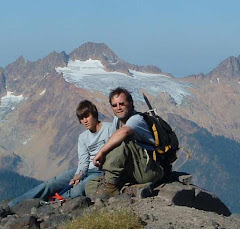
This photo isn't just some random, pretty nature photo but is actually where my eldest son, Bryan, and I spent the last couple of days (just one night). This photo was taken from his phone as my "travel lite" mode prevented me from taking our camera.

So to get to this place, it was just about an hour drive from our house. Then up a steep, gravel jeep trail (but we were in a car) for about twelve miles, then we backpacked in for about four miles.

The photo doesn't show how isolated it is. But it is on a high country area and part of a natural amphitheater containing about twenty square miles of lakes and mountain peaks, snow fields, many bugs, marmots and other creatures . . . but no other humans.

We arrived yesterday about three or four in the afternoon and crawled into our sleeping bags about nine. During this time, I experienced a brief taste of solitude, for the first time in a few years.

I use to be an avid backpacker, but even then (except for a brief stint as a solo backpacker) I always went with loud, active groups . . . such as my own children. Last year backpacking for over a hundred miles in Nepal, I was always surrounded by people . . . too many to be exact.

With just Bryan and me, it seemed lonely. Of course we talked some. But we also read and he went off to explore alone, as did I.

The thing that this experience brought home to me was the concept of solitude. It's uncomfortable. I wanted to have a project to work on, a book that I need to study, a paper to write or a house to work on . . . even a TV or radio would have helped. But I was also thinking that this type of solitude is much closer to what the "Sabbath" represents than anything we know. According to the Bible it is a time of complete rest. It is not clear from scripture if the rest is good for our bodies and our minds but I really believe that it is. Most of all, it is a word picture that we have rest in Christ. No more struggle to "be somebody."

I sat on the side of a lake yesterday looking into the side of a mountain where about thirteen waterfalls tumbled from an ice field just above us. I watched for an hour. All I could hear were the falls, and the echoes . . . which seemed to have a rhythm of music. My mind wondered. I wanted to do something, some project, anything. It was hard to sit and do nothing but let my mind drift on the breeze. But once again, I was reminded that in Christ we rest.

A couple of days ago I watched John Mayer on the Today Show. He just started a new tour. He said the strangest thing. He said that, like most artist, he was happy to go on tour because when he wasn't on tour, he knew that he was just taking up oxygen and space and had no reason to exist. In other words, without his craft, he had no value. That is our great temptation.

But it isn't like Christians are spared or know better. We are the worst at this. We always turn rest into penitence. What was "Sabbath rest" became "Sunday" and the Sunday worship service. It is an act of penitence. A lot of Christians don't like me for the things I say, and this is the one thing I say, which they hate the most. But if you miss church service to you feel a little nasty? I still do and I know better. I certainly do believe there is a very strong place for Christian community. I ache for it. It is neglected by most churches . . . in favor of penitence.

I, in my dream-like state yesterday, was also thinking about "Biblical Christianity." In this case the adjective "Biblical" really means "evangelical culture conformity." If I were a new pastor of an evangelical church and I said that I was going to do things "Biblically" then I cancelled Sunday morning worship and told people that instead, they should go up into the mountains, alone and sit and do nothing. Don't go with a "spiritual" agenda . . . meaning praying (there is a place for prayer so don't get me wrong), singing hymns (unless you can't control your desire to do so), writing in your journal or even meditation. But sit and stare into to the beauty of the mountains . . . or stare at the ground if you want. But be away from any distractions and do nothing. Now that's a Biblical sabbath. But if I did that, I would be run out of town on a rail and a wacky new age pastor.

The closes thing I remember to solitude was when I was with the Navigators and about once every six months we would get alone for "A Day in Prayer." However, it was very different from what I'm talking about. It was penitence . We, in our dualistic thinking, believed that we had to pray very hard . . . to the point of sweating, crying and having some type of emotional (but we called a movement by the spirit) experience or the time was wasted and made God have a sad face.

I want to do this again. It is very uncomfortable to sit and do nothing . . . for hours . . .and still feel that God loves me. But, as Jesus implied to Peter, if He can't love us when we do nothing, then He can't ever love us.

Saturday, July 24, 2010

Sons and Lovers


My new book in my adventure in fiction is Sons and Lovers by D.H. Lawrence. It is number eleven in the top 100 English novels. I picked it, once again, by going down the list at the used book store and this was the first one they had.

I've briefly read about Lawrence. He was quite controversial in his day (early 1900s) for dealing with topics that were considered unmentionable. He was called everything from a pornographer to the most imaginative writer of the 1900s. I'm looking forward to finding out for myself.

I had an interested conversation with my pastor this morning. He dropped by the coffee shop where I was meeting my son. I raised the issue again of the youth leaving churches (including our church) by the droves. He believes that the arts may be a tool for reaching them. I think we might be on the same page regarding the medium, however, I'm not sure if we would be in agreement about the details of that thought.

I will be back. I have out of town guest this week (my son, his wife and my new grandson) and I want to keep my time focused on them.


Wednesday, July 21, 2010

Beer Song


Here's the lyrics of Kimya Dawson's beer song. She sang this one Sunday. She wrote this about her years in substance abuse. She was living in a self-imposed hell. Yet, a generation is walking away from the Church because we've failed to communicate.

The beer I had for breakfast was a bottle of Mad Dog
and my 20/20 vision was fifty percent off.
He said "Punch-buggy red" and punched me right in my left eye.
I said "Don't you mean pediddle?" and I lit his house on fire.
He came home on acid, I was holding his shotgun,
I was dressed like Tina Turner in Beyond Thunder Dome.
He said "Don't shoot", I said "I won't, I love you, you're my friend."
I handed him my wig and shot myself in the head.
Then I stuffed a box of tissues in the hole in my skull,
I got in my Mazda and I drove to the mall.
I bought a big johnson shirt and some silicone tits.
When I pulled out the tissues they were covered with shit.

And the beer I had for breakfast was a box of cheap white wine,
and the boom box on my shoulder was a box of clementines.
I ate every single one without noticing the mold.
You said "You're gross my darling," I said "No I'm rock and roll."

Even though I'd never ever been in a band
I got "cool as black ice" tattooed on my hand
and the Christians gave me comic books as if I would be scared
of burning in Hell, well I was already there.

And the beer I had for breakfast, silver bullet in the brain,
and the beer I had for lunch was a bottle of night train,
and the beer I had for dinner was my crazy neighbor's pills.
We had to sit down on skateboards just to make it down the hill.
Then I peed my pants and you stole the groom's cigar,
and some old man made me watch him masturbate locked in his car.
When I got back to the apartment you were face down on the floor,
you said "Don't go to bed yet, let's go get a 64."

And the beer I had for breakfast was a pint of Jim Beam,
and a fifth of peach schnapps and some warm Sunny D.
And you said "Bottoms up" just as I bottomed out.
I tried to scream "Fuck you" but blood was pouring out my mouth.

And Evan Dando never planned on telling you the truth,
and your Leonardo I.D. card is your fountain of youth.
You can be a teenager for your whole fucking life,
just find some pretty sucker and make that bitch your wife.
I guess by now you all know my friend Danny broke his neck;
he was driving home from Sirens when he got into a wreck.
First I cried for him, and then I cried for me,
haunted by the ghost of the girl I used to be.
But the rocks with holes are warm in my hands,
and I buried my toes in the hot, hot sand,
and the silver pink pony kisses me and says
"You've come a long, long way and you deserve to be really happy."


Sunday, July 18, 2010

Reset -- Is there a Hope for the Next Generation


A few days ago it was the delete button. Today it is the reset one.

This week end has been devoted, unintentionally, to the 18-25 year old crowd. For one, my 24 year old son and his new girl friend came home for the week-end as did my 20 year-daughter. My 22 year old son played in a big concert this morning. But these things are all related because my out of town children came in because of the music festival my one son performed in.

The festival is just ending with the finale . . . which is Kimya Dawson (voice of soundtrack of Juno). She is actually still playing but I came down from the concert, with my 18 year son, to the coffee shop to put down some thoughts . . . or at least the start of them.

All week end I've been listening to the voices of the next generation. This morning, four of them (including my son's girlfriend) and I sat in the coffee shop and talked for an hour and a half in lieu of church. It was a good time.

I went straight from there to the outdoor concert area. My son's band was the first to play. The name of his band is Caulfield and His Magic Violin. My son wrote the lyrics to most of the songs. His friend, Mike (another product of our Evangelical church) wrote the others. They created the title based, of course, on The Catcher in the Rye. It is their statement about rebelling (too strong of a word here) against the status quo of the phonies . . . which would mean my generation. It was when I was trying to understand the name of the band that my, now, 18 year old suggested that I start to read fiction. I did and I started with J.D. and the Catcher.

I will be back and I want to take this further but I can tell my 18 year old is getting bored sitting here and I'm about to become brain dead from his long day.

But my question has to do with how to we reach the next generation with any kind of sense of truth? I'm thinking about Michael Spencer's book, which I read a couple of weeks ago, and his sense of the demise of the Evangelical Church. I'm thinking about HUG's statements today about Evangelicals are making the same mistakes that the old Church made fifteen hundred years ago. Is there anything that we can do? Do we need to hit the "reset" button to our cultural Christianity and start completely over?

I want to come back and share some of the lyrics, which I've heard today. I will just mention one by Mike (who was a Christian child prodigy at our evangelical church a few years ago and his dad is still one of the most conservative leaders). I wish I had all the lyrics to the song as I could not hear all of them. I asked Mike for them after the concert but he didn't have them.

I know that Mike has a powerful influence on my son. I know that he fights with his dad a lot over issues such as global warming and evolution (his dad does not believe in either concept). So the song describes how he had bought into the Christian story until he was 16 then it didn't make sense with "no answers for his brother's pain" and the "crazy ideal about all his friends being destine for a lake of fire."

I've had several talks with Mike. In his view, the conversation is over. He did the Awana thing, the years of youth groups and etc. So now, to even try and speak to the topic is hard. That is when I started feeling hopeless in trying to communicate anything with the next generation I started thinking about a reset button. There are days I would love to throw away everything this next generation has ever heard about Christianity . . . and start all over.


Saturday, July 17, 2010

The Alien

Insomnia runs in my family. My mother, who is 89, still suffers terribly from it. I think it is associated with the anxiety that we all seem to be carriers of as well.

After sleeping like a baby for a month, I've awaken about 3 AM several times this week. I seem to always wake up in the middle of a cold-anxious-sweat. Sometimes the underlying trigger is clear and sometimes it is obtuse. It was clear early this morning.

Last night I had my first "movie night" were we view and discuss provocative movies. Last night was Revolutionary Road. It was a success. Six people, all from my church, came and we had a lively discussion for a good hour.

As I tossed out questions and listened intently to the answers, in my eyes at least, I saw a quick pattern developing. It was my perspective vs the rest of the group. By the time the night was over, it was clear to me (which is the usual case) that I was on a different page and I look very nonspiritual compared to everyone else.

Then, I awaken in the middle of the night having that haunting, lonely feeling like I was in my bivouac on the far side of the moon . . . cut off from the rest of humanity. I didn't just feel like I was on a different page, but residing in a different universe. But I know that emotions and fears call always be skewed . . . seriously so . . . in the middle of the night. I always put myself in the "John Nash" mode (the schizophrenic from A Beautiful Mind) of asking, "Are you (my perspective) real?"

I eventually fell back to sleep. I ran it by Denise this morning (who only made the very end of the discussion because she was in the ER with my son, who broke his foot just as the movie night was starting). She didn't see any issue. But she also didn't catch the two men from church, a few months ago, saying that there is no way you can be a true Christian and believe in an old universe, right after I said I did.

I do feel better but I will lay out the difference in our perspectives and why I feel so alone.

First, a brief synopsis of the movie. It is the 1950s. Frank and April get married and move to suburban America where Frank has to take the commuter train into NYC each day to work a meaningless job (his perspective). He falls into the typical businessman routine including sexual liaisons with one of his secretaries. He and April though, are seeming to be the idealize American family, raising two kids (while serious issues are developing between them). Then they both have an excitement about leaving the rat race, moving to Paris for a personal adventure. That dream is crushed when Franks gets a promotion and April gets pregnant. April is emotionally devastated when the dream fails.

Here is how my perspective and those of the group last night were so different.

The 1950s. The author of the book, Richard Yates, said himself about Revolutionary Road;

I think I meant it more as an indictment of American life in the 1950s. Because during the Fifties there was a general lust for conformity all over this country, by no means only in the suburbs — a kind of blind, desperate clinging to safety and security at any price.

So, my perspective is that the movie rings true to what I know of the 50s and I agree with Yates. I was born in the middle of that decade. But from what I know, I see the materialistic, plastic society within my own family and town. I grew up in the Bible belt but within that belt, everyone aspired to; have personal wealth and appear to have harmony on the surface. Yet, I know many illegitimate children sired by these good Baptist businessmen during the 50s, such as my own uncle. I also remember suicides, closet alcoholics and other dark secrets.

Everyone else in the group agreed with the notion that the media falsely portrays the 50s in a negative light. The pastor mentioned that the peak of church attendance was 1951. No one else in the group admitted any dark family secrets from the fifties as I did. They all said that their families were in harmony and loving and no one had any closet secrets.

But Francis Schaeffer calls the fifties the age of "affluence and personal peace." What he meant by "personal peace" is keeping the facade of harmony and avoiding conflict (on the surface) at all cost.

So, was only MY family and my family's acquaintances messed up during the 50s? It so seems.

Work. The whole group (with me the sole exception) had the perspective that employment is a calling from God. That if you have the right Christian perspective, then work is a great joy. Everyone who spoke to this question admitted that they have this joy about work. One man said that before he was a Christian, that he hated work but now he loves it. He added that retirement is not a Biblical concept and that we should love work until the end.

My perspective (which I didn't share last night for lack of time, and wanting to give others the time to talk) is that work is part of the curse of Adam's fall. We toil. We sweat and most of the time it isn't fun. Not to say that your attitude doesn't count. I mean, there are days I hate the thoughts of going to work. But I do try and keep as positive perspective as I can. There are parts I honestly enjoy.

But in all honestly, if I won 10 million dollars, I would quit work tomorrow. I do see my work as part of my ministry and my part of brining redemption to a broken world but that doesn't blunt the fact that it totally drains the life out of me and I despise it at times. At least three times a week I have to pull over on the highway during my commute home because I am so mentally exhausted that I can't drive safely. The honest truth is that I go to work because I have to go to work because I have to earn money to pay for food, the mortgage and college tuition for my kids.

I did share that my son's (Tyler-22) group says that they never want to fall into the rat race of work that they saw their parents in. That they would rather be dirt poor. A comment was made that if that is true then Tyler must not have seen the Biblical perspective towards work during his growing up (meaning my example I guess).
I was the only one who seems to feel any burden to work.

Dreams and Aspirations. April and Frank had the dream of moving to Paris. Frank, later changed his mind. But this took the life out of April. I personally sided with April on this issue. I really think that Frank sold out to the buck and they would have been much happier if they had followed their dreams.

The consensus of the group is that dreams are a farce. That God wants us to be content exactly where we are in life. That if we look to dreams to bring us happiness, rather than Christ, that we will never find happiness.

But I have a very different view. I see us made in the image of God and part of that image is to be dreamers and explorers. Being content exactly where we are is not a fruit of the spirit in my book.

I love where I live but it came as the result of a dream. All the good in my life came as the result of a dream bearing fruit. I still have dreams. I dream of being a writer, of living on the coast of Italy, of climbing Mt. Kilimanjaro, of learning to sail, of floating down the Amazon and I could on and on. But when I spoke of those dreams, my view was really frowned upon.

About six years ago we were sitting around the dinner table with our kids. Tyler (16 at the time) had just read a book about a man sailing around the world. He asked me, "Dad, why don't we sail around the world?"

I answered, "I would love to."

Tyler, "Are you serious?"

Me, "I'm dead serous. I would quit my job, sell our house, buy a big sail boat and take off."

Tyler, "Then us do it!."

Me, "Ask you mom."

Denise then rolled her eyes and gave about 10 decent, smart, practical reasons why it would be impossible. They included, my daughter having to quit the volleyball team, the loss of my income and the retirement money, taking the kids out of public school thus reducing their chances for college, that I (Mike) don't know how to sail and that there would be no place to plant a garden. I am confident that everyone in the group last night would agree with her totally. Probably everyone on the face of the earth but me. But I envision myself on my death bed in my 80s. I seriously doubt if I will be thinking, "Boy am I glad we didn't sell the house and sail around the world back in 2004." No, if anything, I think I will feel the regret of not doing so.

So, while everyone in the group last night says that dreams and aspirations are signs of discontentment, not one person lives in the town where they were born. You can't move without being carried on the back of some dream, no matter how simple it is.

So, I'm left today thinking where did I go wrong. Am I an alien in this entire world? But I do hear voices that seem to share my perspective at times. Yates saw the same fifties that I did. There must be Christians who believe in dreams. I know there are humans who believe in dreams.

I have to go but I hope to be back to proof read this. Sorry for any typos as I had to type fast, eat a muffin with one hand and sip coffee with the other.